viernes, 23 de marzo de 2012

Is Cuba a state sponsor of terrorism? Let’s get real, State Department

By Brigadier Gen. John Adams, US Army retired, and David W. Jones
Source: http://thehill.com/opinion/op-ed/217483-is-cuba-a-state-sponsor-of-terrorism-lets-get-real-state-department

In 1979, the U.S. State Department began designating countries that “have repeatedly provided support for acts of international terrorism” as State Sponsors of Terrorism. Today, four countries are on the list: Iran, Syria, Sudan and … Cuba.
Seriously, Cuba?
Cuba was added to the list in 1982, due to its support for communist rebels in Africa and Latin America in the 1960s and 1970s. 
Having just returned from an extensive research trip to Cuba, where we met with embassy officials from key European and Latin American countries, the U.S. Interests Section and Cuban government officials, we have concluded that it is simply illogical and counterproductive to keep Cuba on the list. There is little, if any, evidence that Cuba provides support for terrorism, and the evidence further shows that they haven’t for more than 20 years.
After the Cold War ended, many in the intelligence community concluded that Cuba was no longer a national security threat to the United States. The 2008 U.S. State Country Report on Terrorism stated that Cuba “no longer actively supports armed struggles in Latin America and other parts of the world.” The same report further states, “The United States has no evidence of terrorist-related money laundering or terrorist financing activities in Cuba.”
The 2009 report stated: “There was no evidence of direct financial support for terrorist organizations by Cuba in 2009.” The 2010 State Department report stated: “The Cuban government and official media publicly condemned acts of terrorism by al-Qa’ida and affiliates.”
Does keeping Cuba on the list make any sense, more than two decades after the events cited in the original listing? 
So why does the State Department retain Cuba on the list?
The rationale seems to be that “the Cuban government continued to provide safe haven to several terrorists,” according to the 2008 Country Report on Terrorism.
Let’s look at the evidence.
First, the State Department alleges that Cuba offers safe haven to terrorists from Spain.
The fact is that a handful of former members of the Basque Homeland and Freedom organization — more commonly known by the acronym ETA for the Spanish translation — live in Cuba in accordance with a decades-old bilateral agreement with the Spanish government. Spain has stated public appreciation for Cuba’s willingness to host these individuals and has maintained that this enhances their ability to deal more effectively with the group. The Spanish police even maintain a small presence in Cuba.
Second, the State Department alleges that members of the Revolutionary Armed Forces of Colombia (FARC) and the National Liberation Army (ELN) Columbian rebel groups maintain a presence in Cuba. The fact is, Cuba hasn’t supported ELN for more than 20 years. Moreover, the Colombian government publicly stated that Cuba has played a useful role in facilitating peace talks with the rebels, according to a 2007 Congressional Research Service report. 
The 2010 State Department report itself echoes the 2009 report, that “there was no evidence of direct financial or ongoing material support” for FARC.
In addition to the lack of evidence to support the listing, there are convincing reasons why Cuba should be removed:
Cuban presence on the list damages U.S. credibility with almost all of our key allies and puts us at odds with every country in Latin America, who view the listing as capricious and politically motivated.
It impedes our ability to work with allies to facilitate contacts with rebel groups, such as FARC, that are aimed at reconciliation.
U.S. policy cripples efforts to cooperate with Cuba on important American national security issues, including transnational human, drug and weapons smuggling, as well as environmental disasters.
American policy hurts our businesses and workers by providing a rationale to continue the job-killing embargo on trade with Cuba.
Most of all, retaining Cuba on the State Department’s list undermines American efforts in the broader — and very real — fight against terrorism.
For all these reasons, it is time for the United States to end our counterproductive and hypocritical policy and remove Cuba from the State Sponsor of Terrorism list.

Adams is president of Guardian Six Consulting LLC, a national security consulting firm. Jones is a federal lobbyist in Washington.

lunes, 19 de marzo de 2012

Entrega Iglesia Católica a Cuba acta de matrimonio de José Martí (+ Fotos)

18 Marzo 2012
José Martí. Ilustración de José Luis Fariñas con el título "Yugo y estrellas"
La Iglesia Católica Mexicana localizó y rescató de sus archivos el acta de matrimonio del cubano José Martí, en la Catedral Metropolitana, y envió una copia al presidente cubano, Raúl Castro.
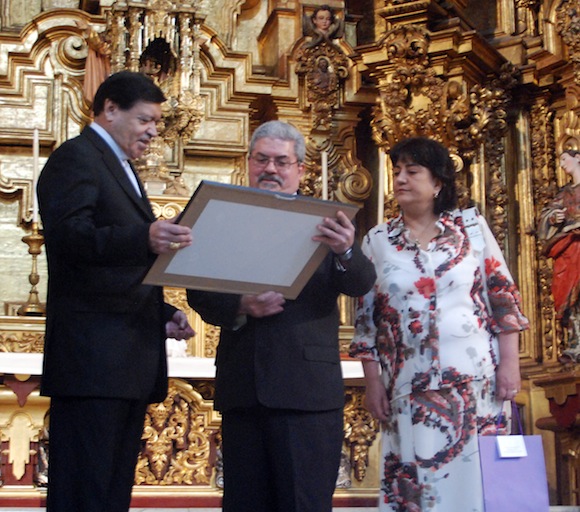
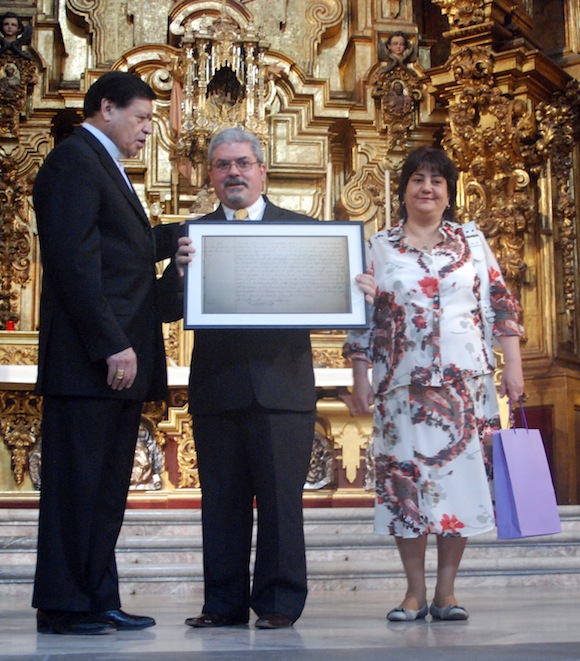
El embajador de Cuba en México, Manuel Aguilera de la Paz, recibió de manos del cardenal Norberto Rivera Carrera dos copias del documento, una para ser entregada al presidente de Cuba, y otra para ser conservada por la sede diplomática del país caribeño en México.
En una visita que hizo el diplomático cubano a la Catedral Metropolitana en días pasados, comentó al Arzobispo Primado de México que el cubano José Martí se había casado en la Catedral Metropolitana durante el primero de sus exilios.
El embajador de Cuba en México, Manuel Aguilera de la Paz, recibió de manos del cardenal Norberto Rivera Carrera dos copias del documento, una para ser entregada al presidente de Cuba, y otra para ser conservada por la sede diplomática del país caribeño en México.
Con base en esa información, el jerarca católico ordenó que se localilzara el acta de esa ceremonia religiosa y tras una búsqueda exhaustiva el documento fue localizado en los archivos del recinto.
De acuerdo con el acta, el 20 de diciembre de 1877 se realizó el enlace matrimonial entre el joven soltero de 24 años, José Martí Pérez y la doncella de 21 años, Carmen Zayas Bazán, luego de cumplir con los trámites religiosos.
Rivera Carrera ordenó hacer copias facsimilares y una vez enmarcadas fueron entregadas esta mañana, en un acto previo a la misa dominical al embajador de Cuba en México, con la encomienda de entregar un ejemplar al presidente de Cuba, Raúl Castro.
(Con información de Notimex)
El embajador de Cuba en México, Manuel Aguilera de la Paz, recibió de manos del cardenal Norberto Rivera Carrera dos copias del documento, una para ser entregada al presidente de Cuba, y otra para ser conservada por la sede diplomática del país caribeño en México.

La ficha técnica para la localización de este documento es:
Archivo Histórico del Arzobispado de México
Partida de matrimonio de José Martí, creador del Partido Revolucionario Cubano, microfilm 248, caja 35, AHAM141
Don José Martí y Pérez y la señorita Carmen Zayas y Bazan. Asentada a la foja 87 siguientes bajo la partida número 158 [al margen]
En la ciudad de México a veinte de diciembre de mil ochocientos y setenta y siete, yo el bachillero don José C. García Marín estando en la sacristía de esta parroquia a las 6 y ½ de la mañana, asistía la celebración del matrimonio que por palabras de presente hicieron legítimo y verdadero don José Martí y Pérez y la señorita Carmen Zayas y Bazan en presencia de los padrinos y testigos que firman la presente.
José Martí [Firma] Carmen Zayas Bazan [Firma]
Como padrino Como madrina
Francisco Zayas Bazan [Firma] Rosa Zayas de Guzmán [Firma]
Como testigo Como Testigo M. A. Mercado [Firma] Manuel Ocaranza [Firma]

miércoles, 14 de marzo de 2012

La Protesta de Baraguá

Hay hombres, nos dijo Martí, que llevan en sí el decoro de muchos hombres. "Esos son los que se rebelan con fuerzas terribles contra los que les roban a los pueblos su libertad, que es robarles a los hombres su decoro. En esos hombres van miles de hombres. Va un pueblo entero, va la dignidad humana".
Así fue el General Antonio Maceo y Grajales.
Cuando —después de diez años de sacrificio y sangre— los débiles y los cansados, los oportunistas y los equivocados se dejaban convencer por la diplomacia del representante de la Corona española en Cuba y aceptaban una paz sin independencia por la cual habían luchado, fue él quien "se rebeló con fuerza terrible" en los Mangos de Baraguá el 15 de marzo de 1878.
Hasta ese momento, Maceo no había sido más que un jefe regional, héroe de cientos de batallas, pero figura todavía secundaria en la dirigencia del Ejército Mambí. Entonces, cuando otros se opacan y ceden, cuando algunos se inhiben —que es un modo táctico de acceder—, él asume toda la responsabilidad heroica y se convierte en el portavoz del decoro de Cuba.
No lo deslumbran los entorchados de los uniformes de gala que visten los enemigos en la memorable entrevista, ni se deja sorprender por frases bonitas o por supuestos honores. Exige lo que debe exigir: la plena libertad de Cuba y la plena emancipación de los esclavos.
Y legó a las generaciones pasadas, actuales o futuras la página más hermosa de la resistencia de los patriotas cubanos: La Protesta de Baraguá.
La escena es breve. Cuando el "Pacificador", el general español Arsenio Martínez Campos trata de leerle el texto del Pacto firmado en el Zanjón, Maceo, enérgico, lo detiene:
—Guarde usted ese documento, no queremos saber nada de él...
Martínez Campos, indeciso, mira a los jefes cubanos. La expresión de estos no deja lugar a dudas. Pregunta a Maceo:
—¿Volverán a romperse las hostilidades?
Y maceo responde, tajante:
—¡Volverán a romperse las hostilidades!
La conversación solo ha durado un instante. Se acuerda una tregua de ocho días. Martínez Campos y sus acompañantes abandonan el campamento mambí. El grito entusiasta de un cubano le sirve de despedida:
—¡Muchachos, el 23 se rompe el corojo!
Para Martí, aquel fue el momento más glorioso de nuestra historia, donde se consolidó la nacionalidad cubana y donde se levantó la memoria de todos los que por ella habían luchado.

viernes, 2 de marzo de 2012

Amor contra el odio, el tiempo y la cólera!

Rene Gonzalez:
I never thought I would have to write this letter
Mar 2nd, 2012    +

My Brother for life,

I never thought I would have to write this letter. We share the same lack of enthusiasm for letter writing, a fact clearly demonstrated during our respective internationalist missions and – more conclusively – in the unique experience of the last 20 years. In other words, only conditions as extraordinary as the present ones induce me to write.
Under normal conditions, these things should said be face to face, and a lot of them wouldn’t even need to be said at all. You have enough on your plate with this pitched battle against a disease that is trying to devour you, without on top of that having to face a human ailment that is much more lethal: hatred.
The hatred that stops me from reciprocating all the efforts, with that well-deserved hug we Five would like to give you.
The hatred that does not let me laugh with you at the each of the happenings that spring from your immense courage.
The hatred that obliges me to guess, by the sound of your breathing on the telephone, the fluctuating fortunes of the battle you are waging.
The hatred that causes me the anguish of not being able to share in the caring for all those who love you; and which stops me from being there to support Sary and the boys.
The hatred that deprives me of seeing our nephews and nieces grow up; they have become men and women in the last few years. How proud you must be of your children!
The hatred that prevents me from simply embracing my brother. That obliges me to follow from an absurd and distant confinement a process of which I should be part, like anyone else who has served a prison sentence, in itself quite long enough and imposed precisely out of hatred; but for him, still insufficient.
What can one do against so much hatred? What we have always done, I suppose: love life and fight for it, both for our own and for that of others. Confront every obstacle with a smile on our lips, an apt witticism, and with that optimism instilled in us from childhood. Press on, tough it out, never give in, always together shoulder to shoulder, however hard they try to isolate me from family and friends, to punish all of us in that way.
Today I’ve been remembering those great days from your time as a sportsman. You in the pool and us up in the stands, shouting your name as you swam. Our voices reached you intermittently, when you raised your head to breathe. You told us how sometimes you heard your whole name, other times just the beginning or the end. So we trained ourselves to wait ’till your head was out of the water and then all shout your name in unison. You couldn’t see us, but the din we made told you we were with you, even if we couldn’t intervene directly in the fierce struggle taking place in the swimming pool.
History is now repeating itself. While you are committing all your efforts to this struggle, I am here cheering you on, now together with the family that you had not then yet built. Although you can’t see me, you know I’m there, together with yours, who are also mine. You know that this brother, from his strange exile, from the sorrow of forced separation, under the most absurd conditions of supervised freedom, based on the dignity of his status as a Cuban patriot (like you) and on the affection nurtured by the ties of kinship and shared experience that unite us, is and always will be with you. Every time you raise your head, you’ll be able to hear me shouting, together with my nephews and nieces.
Breathe, brother, breathe!!
Your brother who loves you,
Rene